

(The English version is below)
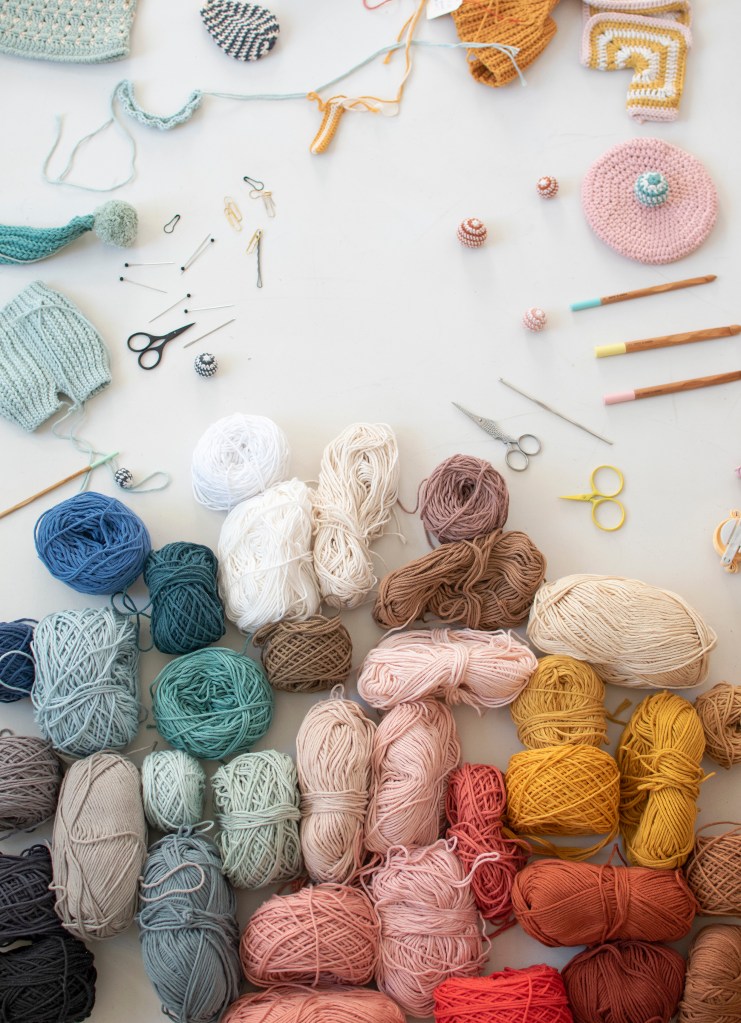
(Esta es una actualización de un post que escribí en 2022. Si quieren leer el post original pueden hacer click aquí)

La elección de un hilado es muy personal, relativa al contexto y posibilidades que tengan (como de cualquier otra cosa en la vida).
Por eso, tengan en cuenta que todo lo que describo a continuación tiene que ver con mi historia en el crochet, lo que he llegado a experimentar, tuve y tengo a disposición en mi país, Argentina. Y, dentro de esas posibilidades, las que prefiero usar para tejer muñecos al crochet.

También- y esto es super importante- sepan que tejiendo muñecos no importa cuál es el grosor de hilado que utilicen, sino que la aguja de crochet o ganchillo y el hilado que tienen a disposición se lleven lo mejor posible para así conseguir el tejido relativamente compacto que necesitamos para que no se vea el relleno ni se deforme el muñeco.
Idealmente, lo mejor es elegir el material que vamos a usar en vivo y en directo, y así probar como se siente el hilado en nuestros manos y, con algo de suerte, experimentar con un par de puntos.
Pero como está posibilidad a veces nos es muy lejana (especialmente por cuestiones geográficas) necesitamos observar con atención algunas características antes de llenar nuestro carrito de compras.
Para eso, intentaremos desglosar la etiqueta clásica de un ovillo.

Lo primero que quiero que noten es el numerito 3 dentro del dibujo de un ovillo.
Este numerito surge de un sistema que desarrolló el “US Craft Yarn Council” en 1980 que clasifica los hilados según su peso: cuántos metros de hilado cada 100 gramos.
Pero vayamos a la tabla en cuestión (pueden ver la original aquí)
| NÚMERO | NOMBRE | TIPO HILADO (CATEGORÍA) | CABOS (HEBRAS) | m/100grs |
| 0 | laso | fingering | 1 – 2 cabos | 600-800 o más |
| 1 | super fino | sock, fingering, baby | 3 – 4 cabos | 350-600 |
| 2 | fino | sport, baby | 5 cabos | 250-350 |
| 3 | ligero | DK (double knitting), light worsted | 6-8 cabos | 200-250 |
| 4 | mediano | worsted, afghan, aran | 10-12 cabos | 120-200 |
| 5 | grueso | chunky, craft, rug | 12-16 cabos | 100-130 |
| 6 | súper grueso | super bulky, super chunky, roving | menos de 100 | |
| 7 | jumbo | jumbo, roving | menos 100 |
Entonces, el 3 corresponde al ligero, o “light” en inglés. Suele tener hasta 8 cabos o hebras (que es la cantidad de hebras que tiene el hilado si le separan esos hilitos finitos retorcidos que forman el hilado) y suele tener entre 200 y 250 metros en 100 gramos.
Ahora bien, si nos ponemos a observar con atención, ninguna de estas clasificaciones es muy exacta sino que nos dan una idea, ni más ni menos, un idea de lo que podemos esperar.
Esto quiere decir que podemos tener un hilado formado por 4 cabos puede ser más grueso que un hilado formado por 8, si las hebras del último son más finitas (cosa que pasa bastante seguido). Lo cual también depende de cómo está hilado. Algunos hilos están retorcidos muy apretados y van a mantener su grosor al ser tejidos, y otros tienen mucho aire y se sienten y ven muy esponjosos pero, según la aguja - y la calidad del hilado- se van a comportar de forma muy distinta (pueden o no mantener el grosor).
Ni hablar que dentro de la misma categoría tenemos un hilado que puede tener en 100 gramos entre 350 y 600 metros. Convengamos que la diferencia de grosor no va a ser menor. Lo mismo con dos hilados con pesos muy distintos por la misma materia con la que están hechos, donde por ejemplo, el agodón es mucho más pesado que el cashmere, por lo que aún teniendo mismo peso y metraje, el algodón va a ser super fino (o el cashmere muy grueso).

En este sentido, al menos en mi experiencia y hablando específicamente de algodón y de muñecos al crochet (porque para prendas siempre conviene hacer muestras)  para saber qué esperar en términos de rendimiento y tamaño final lo ideal es saber el grosor, o sea, la relación entre el peso y el número de metros.
Siguiendo con nuestra etiqueta de ejemplo tenemos entonces:
3- LIGHT - 50g-90m (o 100g-180m). Vamos a dejar el tema del nombre por ahora.
Este último dato, 50g-90 m, es el que me interesa que tengan en cuenta a la hora de elegir algodón para tejer muñecos.
Y que, a pesar de que las etiquetas recomiendan el tamaño de aguja de crochet, una de 5 mm en este caso, esta recomendación está pensada para prendas. Para los muñecos /amigurumis la aguja de crochet siempre va a ser uno o dos milímetros menor (y a veces más) que la recomendada.

Y qué aguja les recomiendo para estos hilados? Yo utilizo una aguja de 2.75 mm con hilados que van desde los 200/210 metros cada 100 g hasta los que tienen unos 170 m. Puede no parecer mucho, pero se nota la diferencia de grosor, así que  acá el manejo de la tensión es fundamental.
Pero, como siempre, son gustos y posibilidades. Un hilado de 180-100 se puede tejer con una aguja 2.5 si tejen muy holgado, o con una 3,00mm si suelen ajustar mucho el punto cuando tejen.

Por otro lado, existen otros sistemas de clasificación, como el cifrado con barra.
Y podemos usar de ejemplo esta misma etiqueta, que dice “Pica Pau Cotton 8/7”
 En Argentina y varios países europeos es común encontrarse con este cifrado. Aquí se está indicando el grosor de cada hebra (es el primer número, el 8) y el número de hebras utilizados para hacer ese hilado en particular (el segundo número, 4, 6, 7, 8 por ejemplo).
O sea, todos los hilados en esa categoría tienen hebras de un grosor similar (el 8), pero uno está hilado con 4 hebras, otra con 6, otras con 8 y, en este caso, con 7 hebras.

Volviendo al cuadro, según el mismo, el hilado 8/7 es DK or Light worsted/ligero porque tiene 7 hebras. Pero si la etiqueta además dice “50g/90m”, que quiere decir que cada 100g tiene 180 metros entraría en la categoría worsted, número 4 o mediano.
Otra vez, recuerden siempre que las nomenclaturas, clasificaciones, categorizaciones nos dan un estimado, una idea de que es lo que vamos a encontrarnos, pero nunca es un absoluto y mucho menos son todas iguales (o tan fáciles de clasificar).

Un pequeño apartado. En Brasil, las etiquetas manejan el número TEX, que hace referencia a la cantidad de gramos por cada kilómetro /mil metros.
O sea que nos está dando la misma información de peso, pero clasificada de otra forma.  Si el número TEX es 492, quiere decir que cada 1000 metros de hilo tenemos 492 gramos de peso (1 kilometro de hilo, o mil metros, pesan 492 gramos). Haciendo regla de tres simple o proporción:
Si 492 gramos son 1000 metros de hilo, ¿cuántos metros tendrán 100 gramos?
El resultado sería 100g/203 m…entre un worsted y un DK, otra vez.

Obviamente, y como les comenté más veces de las que puedo recordar, no importa si hacen muñecos con hilado super finito, mediano o grueso, mientras usen la aguja correspondiente el resultado va a seguir siendo genial.
(This is an update of a post I wrote in 2022. If you want to read the original post, you can click here.)

Choosing a yarn is very personal, relative to the context and possibilities you have (like anything else in life).
Therefore, keep in mind that everything I describe below has to do with my history in crochet, what I've experienced, had, and have available in my country, Argentina. And, within those possibilities, the ones I prefer to use when crocheting my characters.

Also—and this is super important—know that when crocheting toys, it doesn't matter what thickness of yarn you use. What matters is that the crochet hook and the yarn you have available work together as best as possible to achieve the relatively compact fabric we need so that the stuffing isn't visible and the toy doesn't deform.
Ideally, it's best to choose the material we're going to use in person, and then test how the yarn feels in our hands and, with a bit of luck, experiment with a couple of stitches.
But since this possibility is sometimes far away (especially due to geographical reasons), we need to carefully observe some characteristics before filling our shopping cart.
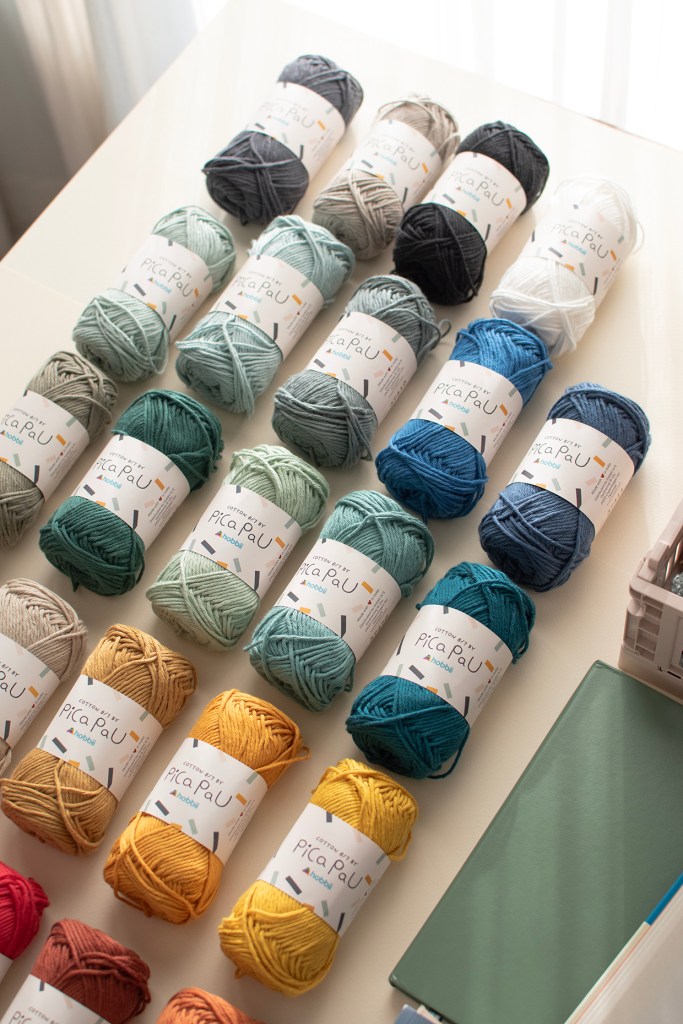
To do this, I'll try to break down the classic label on a ball of yarn (you may see the first picture above).

The first thing I want you to notice is the little number 3 inside the picture of a ball of yarn. This little number comes from a system developed by the US Craft Yarn Council in 1980 that classifies yarns by weight: how many meters of yarn per 100 grams.
But let's go to the table in question (you can see the original here).
| NUMBER | NAME | TYPE OF YARN CATEGORY | PLY | m/100 gr |
| 0 | lace | fingering | 1-2 ply | 600-800 or more |
| 1 | super fine | sock, fingering, baby | 3-4 ply | 350-600 |
| 2 | fine | sport, baby | 5 ply | 250-350 |
| 3 | light | DK (double knitting), light worsted | 6-8 ply | 200-250 |
| 4 | medium | worsted, afghan, aran | 10-12 ply | 120-200 |
| 5 | bulky | chunky, craft, rug | 12-16 ply | 100-130 |
| 6 | super bluky | super bulky, super chunky, roving | less than 100 | |
| 7 | jumbo | jumbo, roving | less than 100 |
So, the number 3 corresponds to light yarn. It usually has up to 8 strands (which is the number of strands the yarn has if you separate the thin, twisted threads that make up the yarn) and usually has between 200 to 250 meters in 100 grams.
Now, if we look closely, none of these classifications are very exact, but they give us an idea, more nor less, of what we can expect.
This means that a yarn made up of 4 strands can be thicker than a yarn made up of 8, if the strands of the o 8 strands yarn are finer (which happens quite often). This also depends on how it is spun. Some yarns are twisted very tightly and will maintain their thickness when crocheted, while others have a lot of air and feel and look very fluffy. However, depending on the crochet hook—and the quality of the yarn—they will behave very differently (they may or may not maintain their thickness).
Not to mention that within the same category, we have a yarn that can measure between 350 and 600 meters per 100 grams. Let's agree that the difference in thickness will not be minor. The same applies to two yarns with very different weights due the material they are made from. For example, cotton is a much heavier  fiber than cashmere, so even with the same weight and meterage, the cotton has to be super fine or the cashmere very thick.
In this sense, at least in my experience, and speaking specifically of cotton and amigurumis (if you are making garments, it’s always a good idea to crochet a gauge sample first), to know what to expect in terms of performance and final size, it's best to know the thickness, that is, the ratio of weight to number of meters.

Continuing with our example label, we have:
3- LIGHT - 50g-90m (or 100g-180m). Let's leave the name aside for now.
This last bit of information, 50g-90m, is what I want you to keep in mind when choosing cotton for crocheting amigurumis.
And although the labels recommend the crochet hook size, a 5mm one in this case, this recommendation is intended for garments. For toys/amigurumis, the crochet hook will always be one or two millimeters smaller (and sometimes more) than the recommended size.

And what hook do I recommend for this yarn? I use a 2.75 mm crochet hook with yarns ranging from 200/210 meters per 100 g to about 170 m. It may not seem like much, but the difference in thickness is noticeable, so tension control is key here.
But, as always, it's all a matter of taste and choice. A 180m-100 g yarn can be crocheted with a 2.5 mm hook if you crochet very loosely, or with a 3.00 mm crochet hook if you tend to crochet tightly.

On the other hand, there are other classification systems, such as the “Slash number”.
And we can use this same label as an example, which says "Pica Pau Cotton 8/7."
In Argentina and several European countries, it is common to find this categorization. It indicates the thickness of each strand (the first number, 8) and the number of strands used to make that particular yarn (the second number, 4, 6, 7, 8, for example).
In other words, all yarns in that category have strands of a similar thickness (8), but one is spun with 4 strands, another with 6, others with 8, and, in this case, with 7 strands.

Returning to the table, according to it, 8/7 yarn is DK or Light worsted because it has 7 strands. But if the label also says "50g/90m," which means that every 100g has 180 meters, it will fall into the worsted category, number 4, or medium.
Again, always remember that nomenclatures, classifications, and categorizations give us an estimate, an idea of what we're going to find, but it's never absolute, and much less are they all the same (or so easy to classify).

A brief aside. In Brazil, labels use the TEX number, which refers to the number of grams per kilometer/thousand meters.
In other words, it's giving us the same weight information, but classified differently. If the TEX number is 492, it means that every 1,000 meters of thread weighs 492 grams (1 kilometer of thread, or 1,000 meters, weighs 492 grams). Using a simple rule of three or proportion:
If 492 grams are 1,000 meters of thread, how many meters will 100 grams have?
The result would be 100g/203m... somewhere between a worsted and a DK, again.

Obviously, and as I've told you more times than I can remember, it doesn't matter if you make amigurumis with super fine, medium, or thick yarn, as long as you use the right crochet hook, the result will still be great.



 picapauyan.com
Leave a comment